Retatrutide,
done properly.
Most research-grade reta vials go cloudy, lose potency, or arrive contaminated. Ours doesn't — because the formulation, the bacteriostatic water, and the cartridge were all engineered together. Here's what makes the difference, and how to use the cart from first dose to last.
Why our retatrutide is better
Retatrutide is a lipidated peptide — a fatty acid tail bolted onto the protein backbone. That tail is what research associates with its long half-life, but it is also why most research-grade product fails. The fatty tail is described as wanting to stick to glass walls, associate with other molecules, and drop out of solution the moment pH drifts off-target.
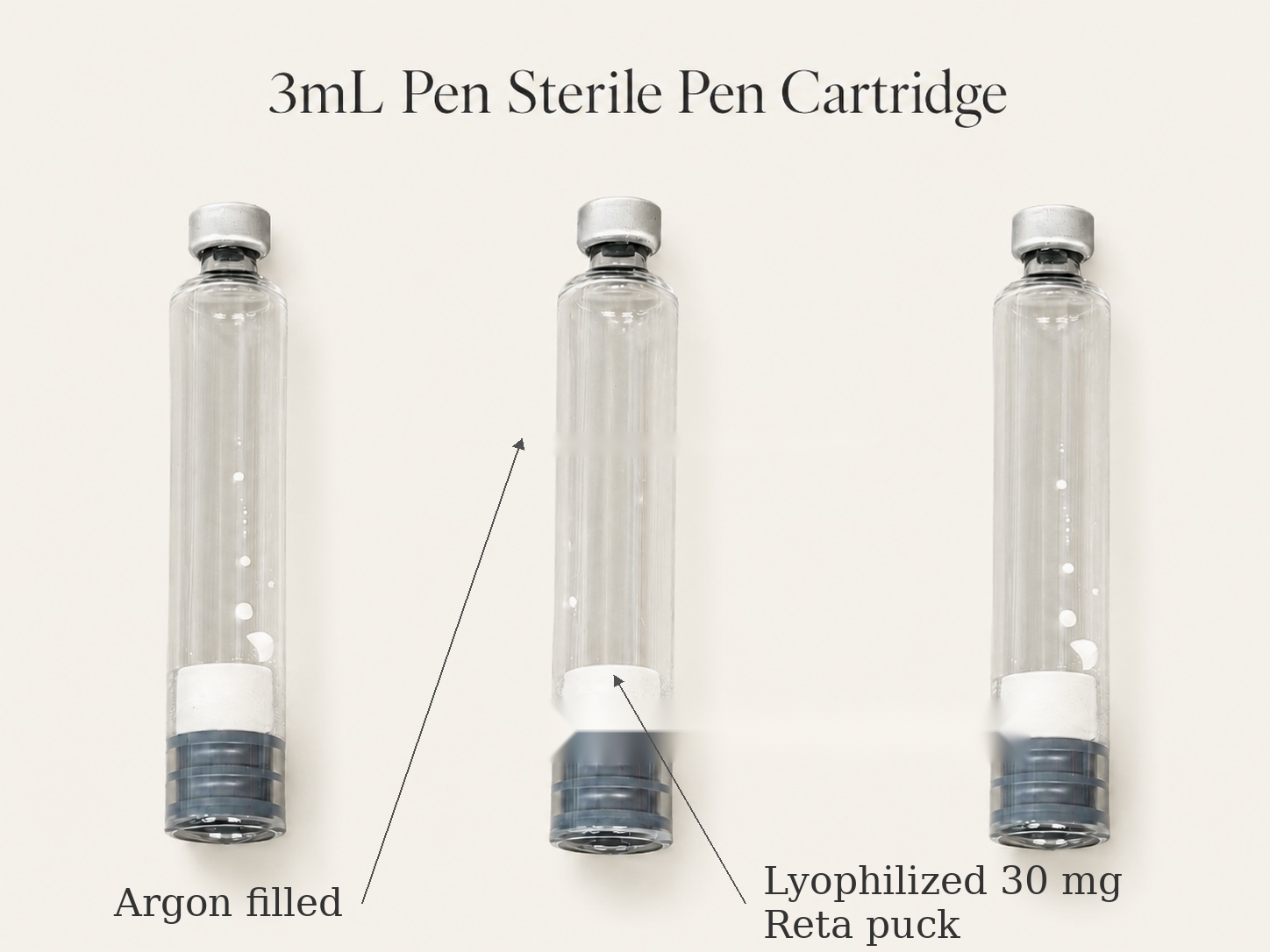
We formulated around every one of those failure modes. Ours is not powder in a vial — it is a complete formulation with a buffer system, a chelator and a heavy lyoprotectant matrix baked directly into the lyophilised cake, so every stabilising excipient activates in the same instant the peptide does.
The result: clear solution on contact, stable for the life of the cartridge. No cloudiness. No chunks. No "wait an hour and swirl harder."
The bacteriostatic water is engineered too
Every Reta-30 ships with a matched bacteriostatic water vial, and it is not a commodity diluent. Its starting pH is chosen so the cake's buffer system lands the reconstituted solution on target, and it is argon-sealed on the same line as the cartridge — because a perfect cartridge reconstituted with oxygenated water is not a protected product.
Why pen cartridges are better
A traditional vial sits there with the same headspace volume forever — every dose you pull, room air gets drawn back through the needle to replace what you took out. By the end of the vial, your last dose is sharing space with weeks of accumulated bacteria, oxygen, and dust nuclei. This is the single biggest reason reconstituted peptides degrade.
A pen cartridge works the opposite way. As the plunger advances with each dose, the air space shrinks instead of growing. By your last dose, there's almost no headspace at all — and what little exists has been steadily compressed and pushed out, not exchanged with the room.
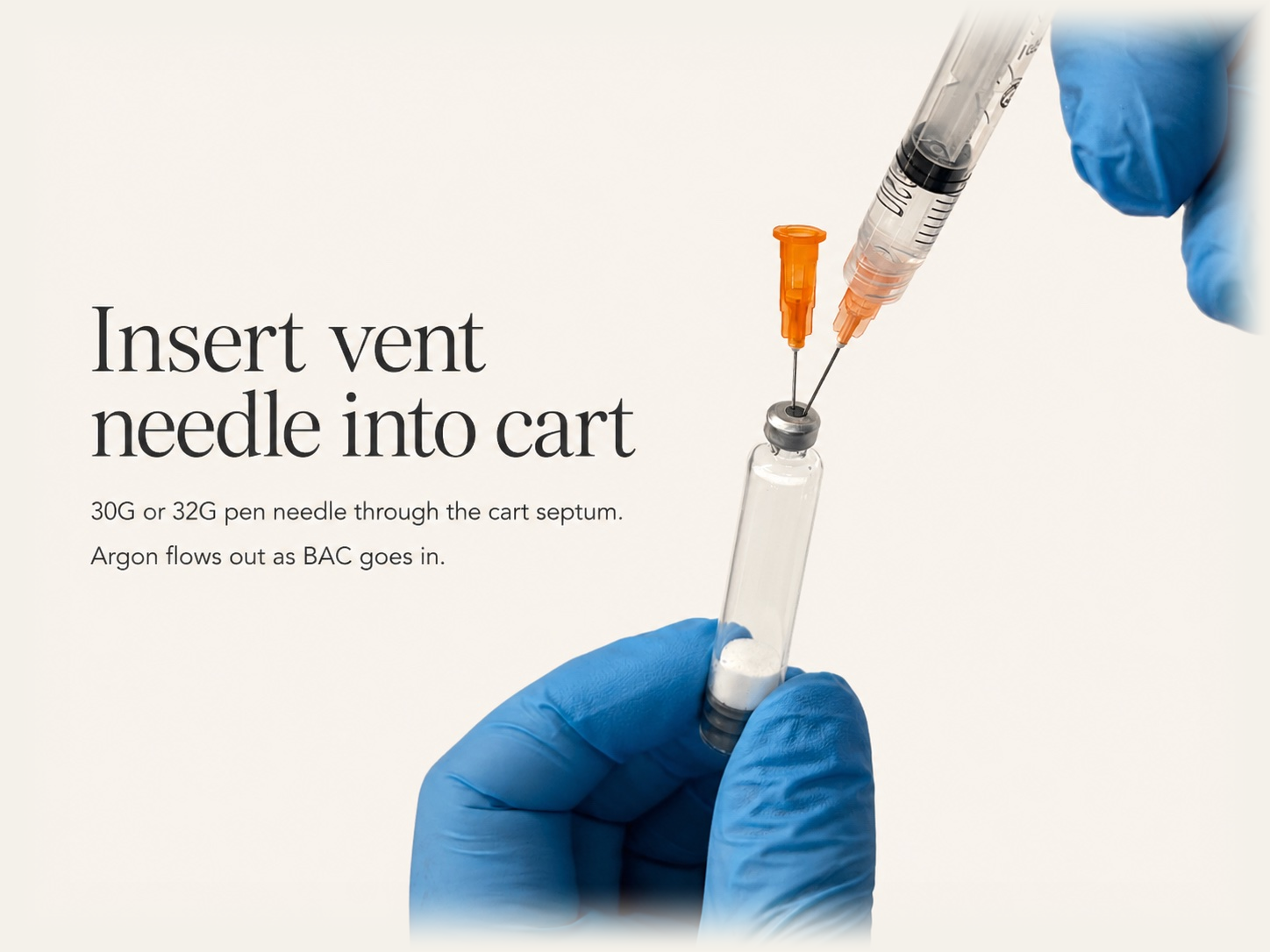
Combine that mechanical advantage with how you reconstitute the cart in the first place — argon vents out, BAC water pushes in, never room air — and you get a sealed system from end to end. Bacteria physically cannot enter against the outward gas flow during reconstitution, and once sealed, the plunger compression keeps it that way.
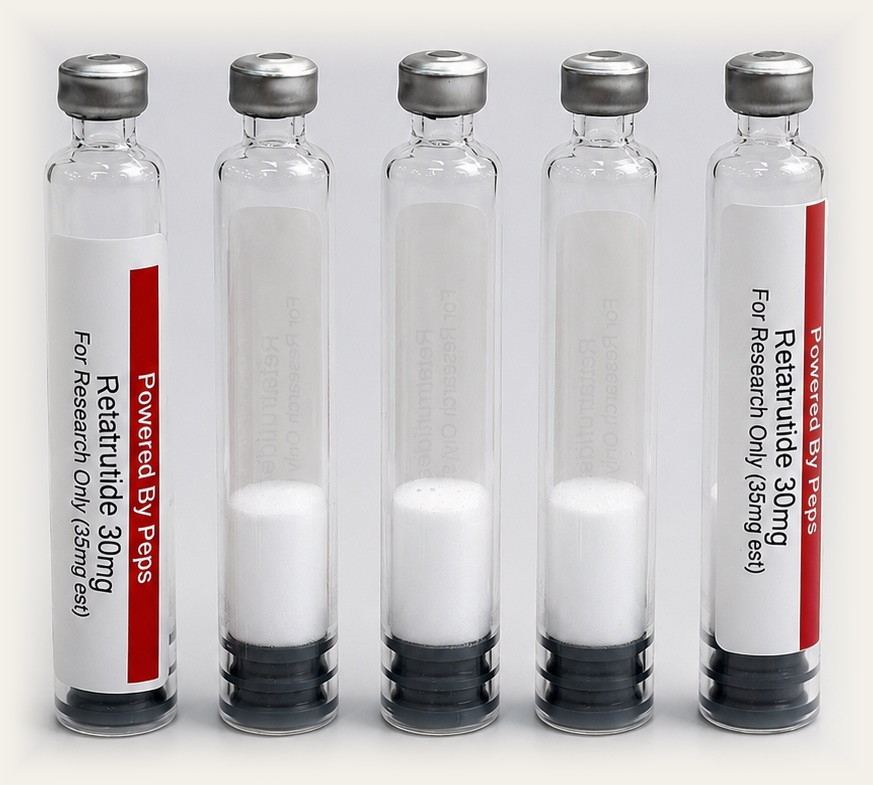
Why ours is still working when theirs is gone.
Reconstitution — your BAC goes into the cart
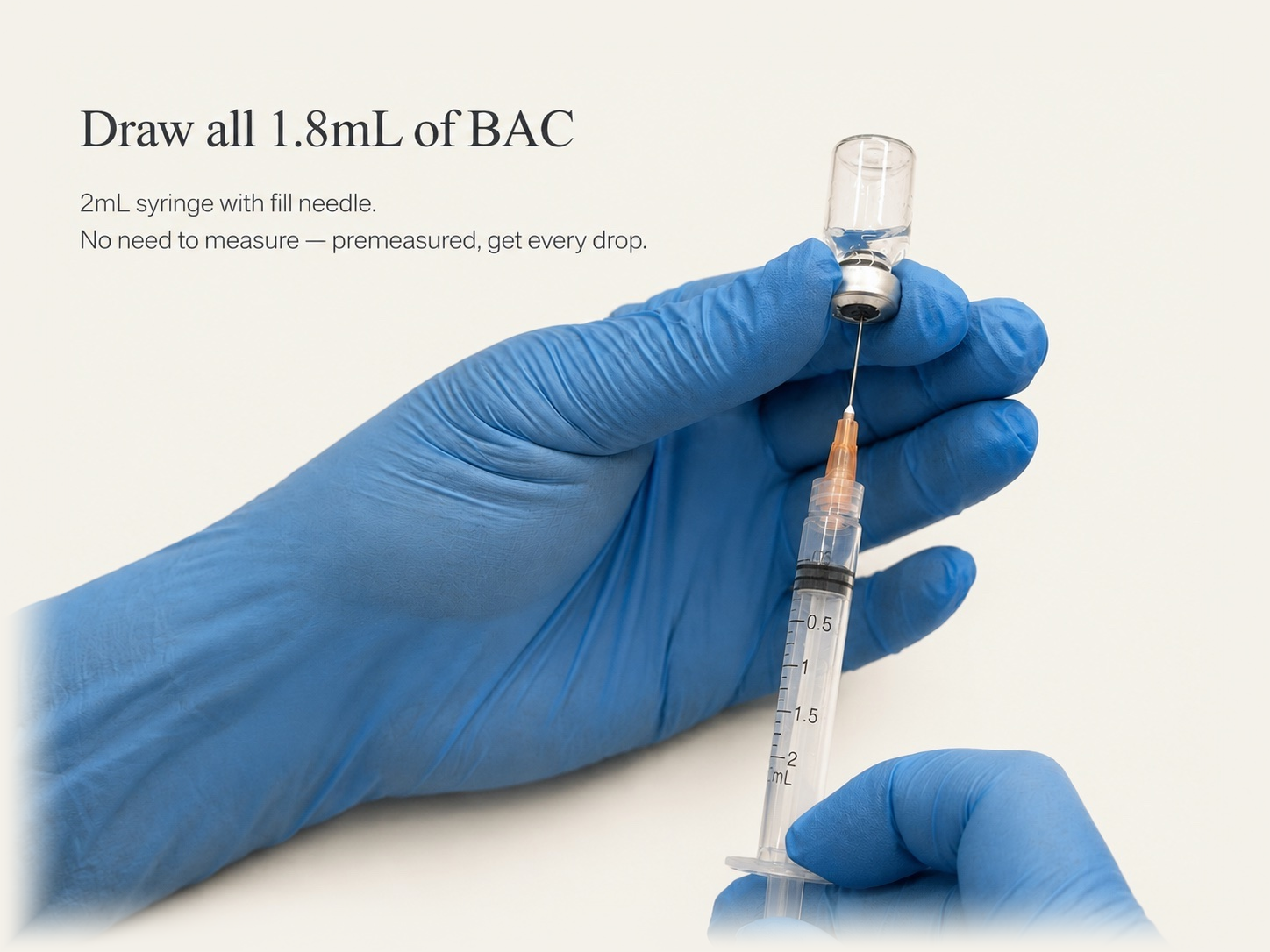
Each Reta-30 ships with a matched 1.8 mL bacteriostatic water vial. You transfer all of that BAC into the pen cartridge. The cart then dispenses against a 1.6mL working volume — the extra 0.2mL fills the dead space inside the pen mechanism so every dialed unit lands in the tissue, not lost in the device.
Pushing the air out — first prime & every dose
After reconstitution, a small pocket of argon mixed with a bit of dissolved gas will sit at the top of the cart. You want to push as much of it as possible out before your first dose. This shrinks the headspace for the rest of the cart's life — less air to absorb into solution, less surface area for the peptide to lose to oxidation over weeks of use.
The good news: priming the pen handles this automatically. Each prime push moves the plunger forward, compresses the gas pocket, and vents it through the needle. Once it's out, it can never get back in.
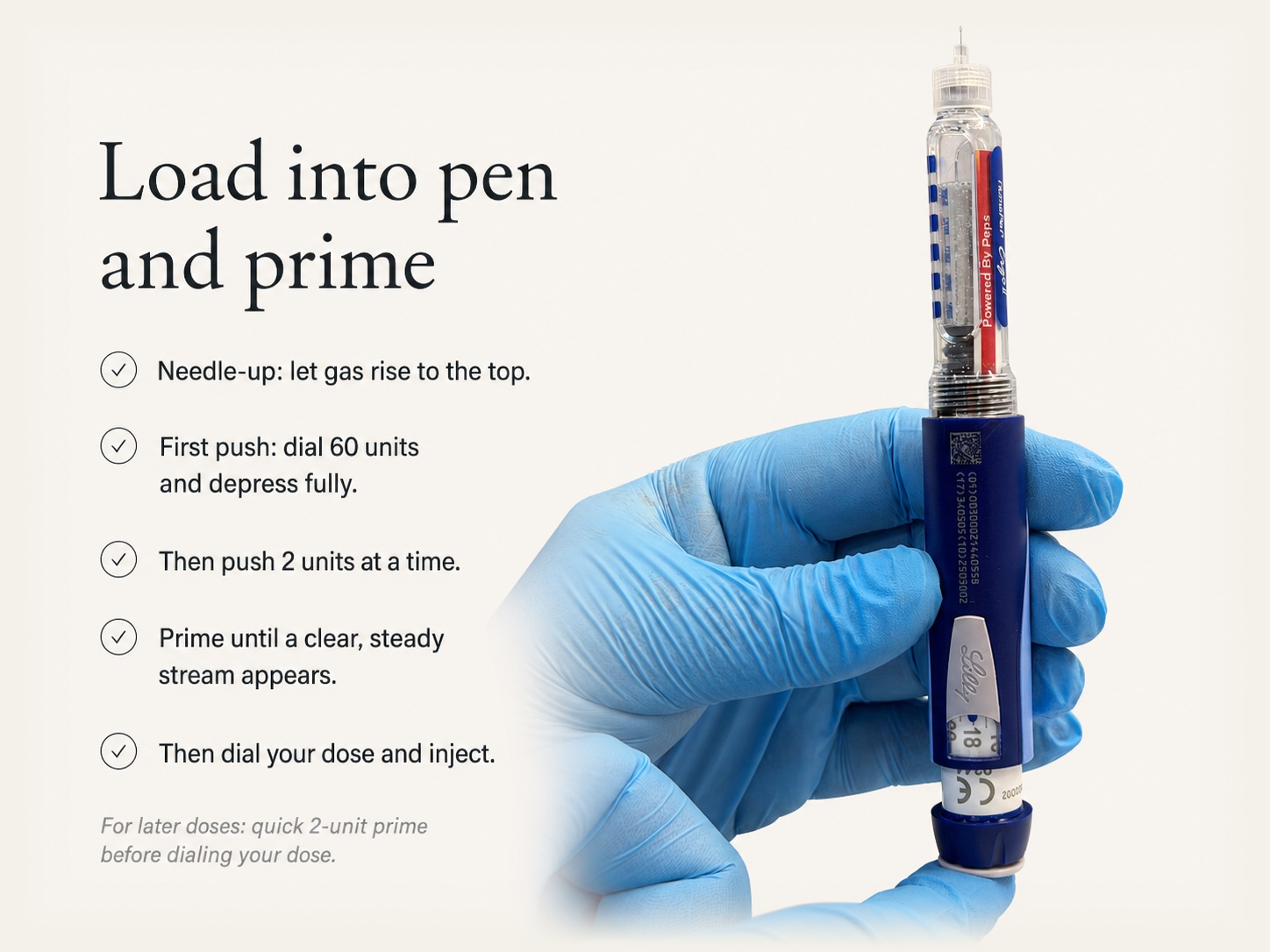
- Hold the pen needle-up so any gas pocket migrates to the top, near the needle.
- First push: dial a full 60 units and depress fully. Because we know exactly 1.8mL of BAC went into the cart, a 60-unit push is safe and will clear most of the headspace gas in one shot.
- After that, slow down. Dial 2 units at a time, push fully, and watch the needle tip. You'll see nothing at first — that's normal, you're still pushing gas out.
- Keep going 2 units at a time until a clear, steady stream of fluid shoots out of the tip. That stream is your confirmation — fluid is at the needle, gas is gone.
- Cart is purged. Dial your dose and inject.
- Every subsequent dose, do a quick 2-unit prime needle-up before dialing your real number. Confirms the line is clean, keeps the cart sharp through the last dose.
Dosage — Reta-30 titration
| Phase | Weeks | Weekly dose | Pen units | Volume |
|---|---|---|---|---|
| Initiation | 1-4 | 2mg/week | 11 | 0.11 mL |
| First Escalation | 5-8 | 4mg/week | 21 | 0.21 mL |
| Second Escalation | 9-12 | 8mg/week | 43 | 0.43 mL |
| Maintenance | 13-48 | 12mg/week | 64 | 0.64 mL |