The diluent is half the formulation.
A perfectly formulated, argon-sealed cartridge reconstituted with oxygenated, pH-random water is not a protected product. The water is where a great many otherwise-good formulations quietly fail — so ours is engineered to the same standard as everything else that leaves here.
Why our BAC water is better
BAC water seems simple — just sterile water plus 0.9% benzyl alcohol — and most vendors treat it that way. We don't. Our BAC is fluid-engineered for peptide reconstitution from the moment the vial is filled.
First: argon-flushed during fill. Same protocol as the cartridge itself. Room air never sits over the BAC water. That means zero dissolved oxygen entering your cart at reconstitution — the moment when the peptide is most vulnerable.
Second: argon-packed in the vial. Headspace above the BAC is pure argon, sealed at atmospheric pressure. The BA preservative handles bacteriostatic protection; the argon handles oxidation protection. Two layers, working at the same time.
Third — and this is the part nobody talks about — our BAC is pH-balanced to 5.8–6.0. Most BAC sits wherever benzyl alcohol's natural pH happens to land, which means every batch is slightly different and every reconstitution is a small experiment. Ours is deliberately tuned to a tight, predictable window — and that window matters for two completely different reasons.
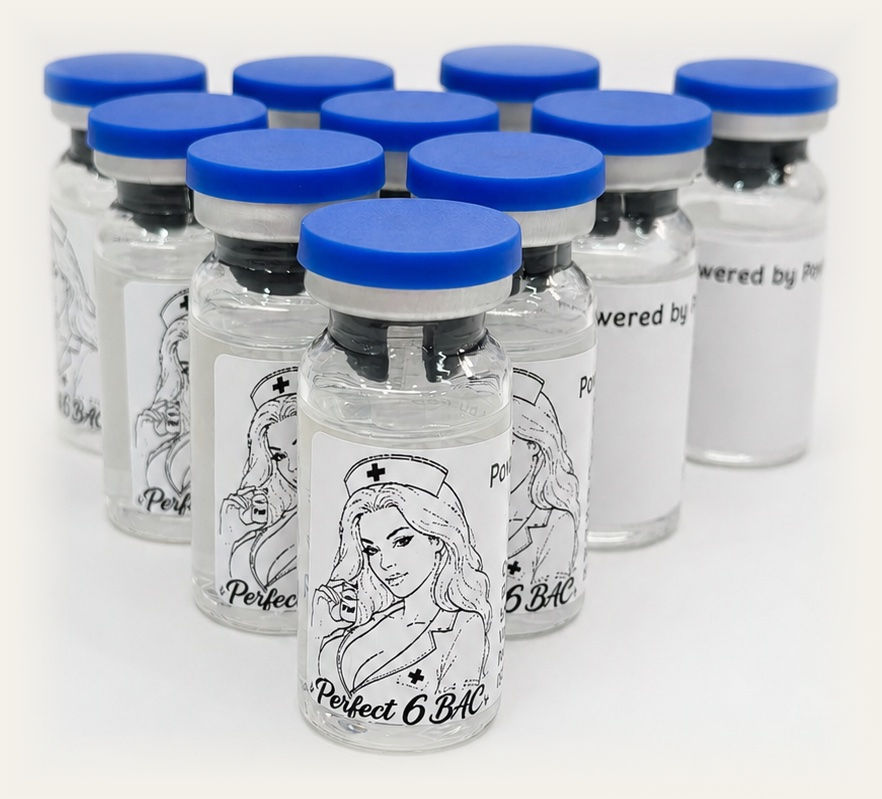
For a buffered peptide formulation: a clean 5.8–6.0 starting point lets our cake's buffer system reliably pull the final solution down to its target landing pH of 5.5. Most research-grade formulations carry no cake buffer at all — so their final pH is whatever random number the BAC happened to be that day. Ours is engineered end-to-end.
For products that can't use pH buffers at all — copper peptides like GHK-Cu (the active ingredient in KLOW) physically cannot tolerate histidine, EDTA, or phosphate buffers because those excipients either chelate the copper or strip it out of the peptide entirely. For these formulations the BAC water is the only pH control there is. Our 5.8–6.0 spec lands them safely in the copper-stable range every single time. Standard unmonitored BAC can put them anywhere from pH 4 to pH 7, and the copper falls out of the complex on either extreme.
One system, both halves. The cartridge and the water it is reconstituted with are purged on the same line, to the same specification. Protecting one and not the other protects neither.